
 Dima is 22 years old and he has lived in a children’s home since he was four. This January he left and our partner organisation, Sunflower, was with him all the year. The preparation year was an anxious one. Dima was worried that something would go wrong with the accommodation he was promised. When his room was ready he didn’t move into it straight away. To start with he was only let out at weekends, which made his angry with his teachers. He fell out with his girl-friend too because she wouldn’t come shopping with him for his new room. Dima’s anxiety worried the staff at his children’s home so much that he was sent to the educational psychologist to establish whether he was capable of living independently.
Dima knows almost nothing about his family, just the names of his parents and that he had a brother who died before he was born. He also found out that he has a heart condition, but not how serious it is. He only knew “that I have something terrible wrong with my heart. The doctor at the children’s home said that it is dangerous. I could die at any moment.” Step by step Dima gathered all the necessary documents, was passed by the educational psychologist, and was given his medical records. All through he would come to Sunflower with his questions. Each time he was given some new information he would think about it carefully. Now he says, “it turns out that my illness isn’t that terrible. I simply have to avoid putting a heavy strain on my heart. I was given all the necessary treatment when I was little”.
When Dima finally moved into his bed-sit, he had difficulties which he wasn’t prepared for. He is frightened to take decisions, is scared to break into his small savings, and finds it difficult to be alone after work. He discusses these worries with Sunflower and they are teaching him how to manage a budget and helping him find ways to spend his spare time.
Dima comes to Sunflower’s support group and is beginning to open up with his peers. He’s also started chatting to his colleagues, not just to the lads from his children’s home. He says, “when I first came to Sunflower, I thought that it wasn’t for me. I kept quiet and was scared of the teachers. Now I see how the new guys behave and I even try to help them a bit so that they can get used to it. Before I would just think about how other people were reacting to me, but now I’m learning to pay attention to other people and to be interested in how they live and what they are thinking.”
Dima’s story shows how vital it is to look after the mental health of young people leaving the orphanage system. Sunflower listens to their fears and we also give them the skills to tackle their problems head on. None of this is quick or easy, but, thanks to their support, Dima will still be benefitting for many years to come.
If you’d like to help Sunflower continue their vital work you can donate at any time. However, if you donate via our page on Global Giving between 9th and 13th April, 2018 a 50% bonus may be added to your donation up to £35 or $50.

 Gleb is 19 and an only child. He does not speak because of a rare genetic syndrome, which affected his development from the first months of his life. He needs to be accompanied and helped in his daily life. Gleb is a sociable and determined young man and he is happiest when he is busy. But he can only communicate by a gesture or a sound so communication is critical for his development, making new friends and exploring the outside world. Unfortunately there are simply no other facilities in Moscow which can offer disabled young people a chance to be active in the community and give them a different perspective on life.
 Many years ago, St Gregory’s Foundation provided funding for the parish in Kondopoga to have on its land a small sawmill and a woodwork workshop (which made furniture and used the saw wood profitably too) and all that went with it. Unfortunately in time these stopped being commercially viable and they closed. We at St Gregory’s accepted that things like that happened…
 Liza’s multiple disabilities have made life more challenging for her and her family. She has cerebral palsy and poor sight. When our colleagues first met Liza she couldn’t sit or stand unaided, or use her left hand. She could only play with the simplest toys, like a rattle, and, being unable to talk or express herself, she easily got frustrated and angry.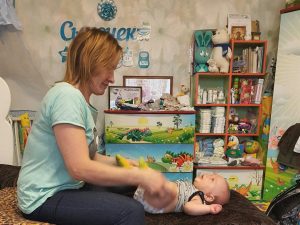
 Download our newsletter to find out how Sunflower is preparing parents who grew up in orphanages for their summer camp, how our physiotherapist colleagues are turning distrustful parents into allies in their children’s care, and how we’ve helped formerly homeless young men to overcome disappointment and depression.
 Julia Ashmore has recently returned from a visit to St Petersburg to meet our partners. While she was there, she introduced a group of 30 trainee teachers from Leiden in the Netherlands to our colleagues and pupils at Dinamika School for disabled children. They had found out about Dinamika through our website and wanted to find out what education was available to disabled children in Russia. They were positively surprised by what they found. They were particularly impressed by the equipment that teachers at the school had made or adapted themselves to meet the needs of the children, and by the facilities that St Gregory’s had a hand in providing: the model flat for teaching domestic skills, the craft workshop and the well-equipped gym. This was an excellent opportunity to introduce our work to a broader circle of young people and raise our profile and share our plans.
